
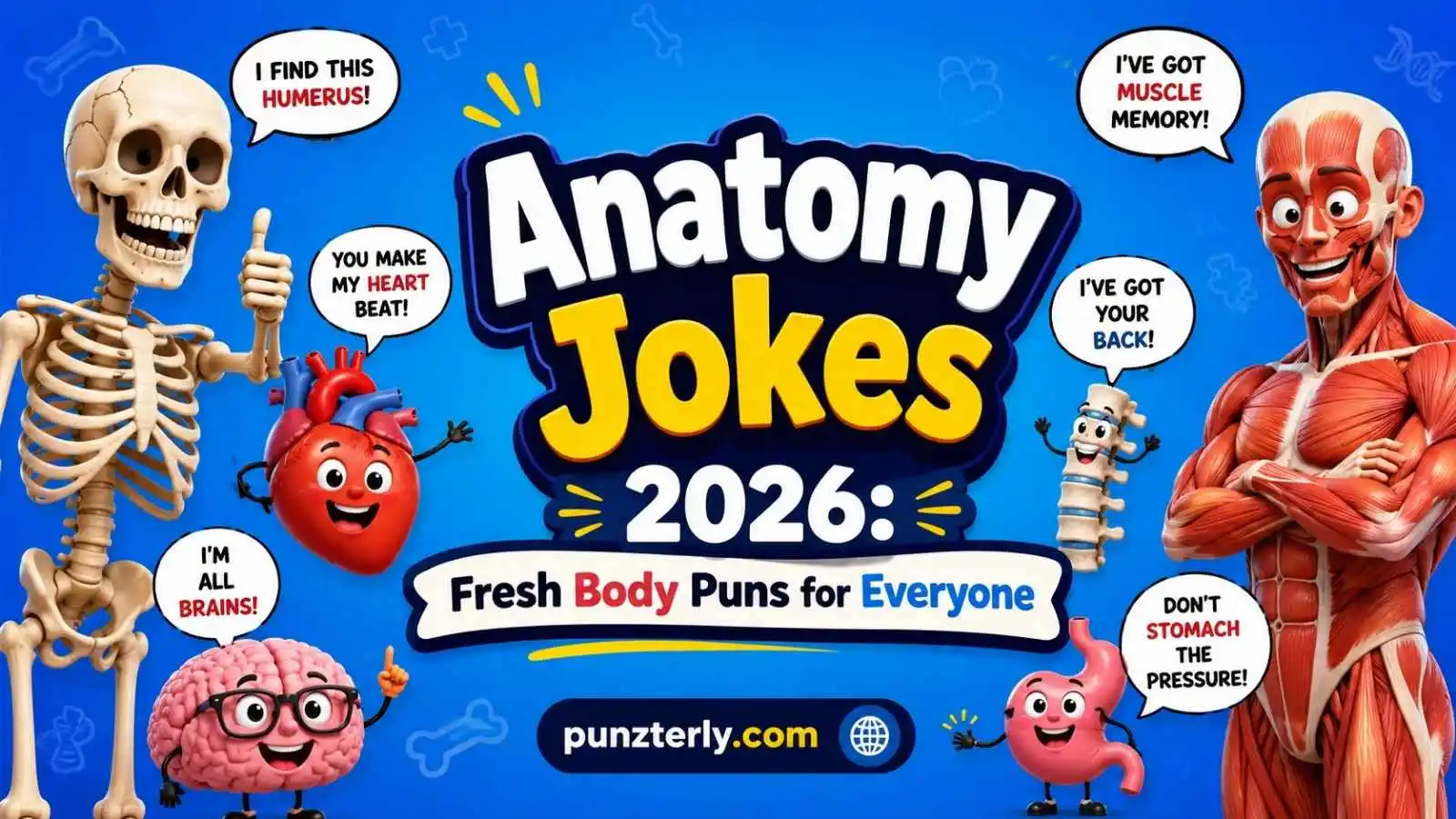
Anatomy jokes 2026 are perfect for families, classrooms, study groups, captions, and anyone who loves smart body humor. This list keeps things clean, quick, and easy to share without leaning on awkward medical jokes or tired punchlines. Inside, you’ll find original puns grouped by theme, from bones and brains to hearts, muscles, organs, and study breaks. Also, each line stays short enough for cards, class boards, social posts, and casual laughs.
Quick Answer
Anatomy jokes 2026 are clean, body-themed puns that use bones, organs, muscles, senses, and science terms for quick humor. They work best when the wordplay is simple, kind, and easy to understand.
TL;DR
• Pick simple body words first.
• Keep classroom jokes clean.
• Use short lines for captions.
• Match puns to the audience.
• Avoid risky medical claims.
• Save favorites by theme.
Anatomy Puns One Liners
These quick lines work well when you need a fast laugh. Also, they’re short enough for notes, boards, and captions.
• Anatomy class has real body language.
• My notes have a strong pulse.
• This lesson really found its organs.
• I’m built for structured humor.
• That diagram has excellent comic timing.
• My skeleton appreciates solid material.
• The lab had a lively framework.
• I’m studying from head to pun.
• These jokes have inner support.
• My textbook is full of character.
• That quiz had nervous energy.
• Good anatomy humor has layers.
• The body always delivers punch lines.
• This topic has great form.
Anatomy Puns for Kids
Kids need jokes that feel silly, safe, and easy. Therefore, these lines use familiar body words without confusing details.
• My elbow loves bending the rules.
• The toe joined dance class.
• My teeth started a smile club.
• The nose knows snack time.
• My fingers voted handily.
• The knee made a tiny bow.
• My ears heard snack rumors.
• The tongue gave a taste report.
• My arms hugged the homework.
• The belly joined the giggle team.
• My hair had a bright idea.
• The feet held a step meeting.
• My cheeks turned into laugh cushions.
• The chin kept things up.
Anatomy Jokes for Students
Students need humor that fits flashcards, exams, and study breaks. Meanwhile, these puns keep the stress light.
• My flashcards have backbone today.
• Study group? Count me organ.
• The quiz tested my nerves politely.
• My notes needed better circulation.
• That diagram gave me direction.
• I passed by a hairline margin.
• My brain requested extra storage.
• The lab report had muscle tone.
• Finals are a full-body workout.
• My pencil developed wrist support.
• The syllabus has skeletal structure.
• Group study keeps knowledge jointed.
• My memory stretched before class.
• This chapter really grew on me.
Anatomy Jokes for Medical Students
Medical students like sharper wordplay, but it still needs to stay clean. Besides, good lab humor should never feel mean.
• My study plan needs vital signs.
• The atlas keeps me well oriented.
• My caffeine levels show strong reflexes.
• Lab partners make excellent support tissue.
• I reviewed until my notes palpated back.
• My mnemonics have clinical charm.
• The lecture had excellent bedside manner.
• My exam prep is under observation.
• The syllabus prescribed more revision.
• My highlighter found the main artery.
• I’m charting a path through chapters.
• The anatomy atlas has patient pages.
• My schedule needs a recovery period.
• This module has strong academic posture.
Bone Puns
Bone humor is classic, but fresh wording makes it better. So, these lines avoid the same old recycled cracks.
• My skeleton runs a tight framework.
• The clavicle dressed collar-smart today.
• My femur prefers long-form comedy.
• The ribs hosted a cage-free laugh.
• My skull keeps brilliant ideas upstairs.
• The pelvis balances every argument.
• My joints formed a moving committee.
• The tibia took a stand.
• My bones prefer dry humor.
• The patella enjoys front-row seating.
• My skeleton supports the whole joke.
• The wrist kept things flexible.
• My ankles handle plot twists.
• The jaw dropped by appointment.
Heart Puns
Heart puns are great for sweet notes and friendly posts. However, they work best when the tone stays warm.
• My heart edits in red.
• You keep my kindness circulating.
• This joke has a steady beat.
• My feelings filed a pulse report.
• The heart joined rhythm club.
• Your smile improved my cardiac playlist.
• My mood has heart-forward energy.
• That compliment traveled aorta way.
• The heart signed every thank-you note.
• I’m keeping this laugh close-chested.
• My kindness runs on beat mode.
• The heart prefers sincere punchlines.
• This friendship has healthy rhythm.
• My day needed a pulse boost.
Brain Puns
Brain jokes work well for students, teachers, and nerdy captions. Plus, they make smart humor feel light.
• My brain opened a thought bakery.
• These ideas are fully cranial.
• The cerebellum balanced the punchline.
• My memory filed a laugh request.
• The neurons started a spark chat.
• My thoughts formed a study circle.
• The cortex prefers layered jokes.
• My brain needs fewer pop quizzes.
• This pun activated snack thinking.
• The mind mapped a giggle route.
• My logic took a coffee break.
• The lobes held a board meeting.
• My ideas traveled synapse-class.
• The brain loves clever connections.
Eye Puns
Eye puns are perfect for visual posts and classroom boards. Also, they’re easy to adapt for art, photos, and notes.
• My eyes joined the focus group.
• The iris added color commentary.
• This view deserves pupil approval.
• My lashes framed the punchline.
• The retina saved the scene.
• Eye contact made the joke clearer.
• My vision has bright timing.
• The lens corrected my attitude.
• These notes look insight-full.
• My eyebrows raised the standard.
• The pupils took attendance.
• This diagram is worth a glance.
• My eyes prefer sharp humor.
• The blink delivered perfect timing.
Ear, Nose, and Throat Puns
These sensory puns are clean, quick, and easy to read aloud. As a result, they work nicely in classrooms and captions.
• My ears joined the sound committee.
• The nose detected fresh comedy.
• My throat cleared the stage.
• The tongue tasted victory politely.
• My smile filed a dental brief.
• The ear stayed tuned in.
• My nose follows scent-sible plans.
• The voice found its range.
• My teeth formed a bright lineup.
• The tonsils requested backup singers.
• My tongue has tasteful timing.
• The gums supported every smile.
• My hearing has excellent reception.
• The mouth delivered closing arguments.
Muscle Puns
Muscle puns fit gym captions, biology class, and confident jokes. Still, the best ones lift the mood gently.
• My biceps brought strong opinions.
• The triceps handled backup support.
• My muscles signed a flex contract.
• The abs organized core values.
• My workout found comic strength.
• The deltoids shouldered the joke.
• My calves stepped into action.
• The hamstrings kept things moving.
• My muscles prefer heavy laughter.
• The quads made a power point.
• My strength has good form.
• The forearm handled the details.
• My body built a punchline.
• The glutes backed the plan.
Spine and Back Puns
Back and spine jokes are great for confidence, support, and posture. In addition, they make strong lines for study boards.
• My spine keeps the plot upright.
• The vertebrae formed a support group.
• My back carries great material.
• The posture report stood tall.
• My shoulders passed the support test.
• The spine prefers straight comedy.
• My backbone handles tough chapters.
• The discs kept things balanced.
• My backstory has structure.
• The neck turned toward success.
• My posture upgraded the mood.
• The spine aligned the punchline.
• My back deserves credit.
• The vertebrae stacked the laughs.
Hand, Arm, and Shoulder Puns
These puns fit teamwork, friendship, work, and school projects. Moreover, they’re simple enough for signs and captions.
• My hands applauded the idea.
• The fingers counted on teamwork.
• My thumb approved the lesson.
• The wrist kept plans flexible.
• My arms embraced the assignment.
• The shoulder carried the caption.
• My palm read the room.
• The elbow joined negotiations.
• My forearm handled heavy notes.
• The fingers typed with flair.
• My hands made a gripping point.
• The shoulder offered quiet support.
• My arms reached new standards.
• The wrist signed off smoothly.
Leg, Knee, and Foot Puns
Leg and foot jokes are useful for sports, movement, travel, and daily humor. Likewise, they stay friendly when the wordplay is simple.
• My legs took a stand.
• The knees held a bend meeting.
• My feet followed the plot.
• The ankle supported sudden turns.
• My toes stayed on point.
• The heel kept things grounded.
• My stride found comic rhythm.
• The shin faced the spotlight.
• My footnotes walked into class.
• The knees approved flexible thinking.
• My legs carried the conversation.
• The toes formed a tiny lineup.
• My steps made progress punny.
• The sole understood the assignment.
Organ Puns
Organ puns can be clever without sounding clinical. Therefore, these lines keep the humor light and general.
• My lungs appreciate airy jokes.
• The liver processed that compliment.
• My stomach handled the suspense.
• The kidneys filtered out bad vibes.
• My pancreas sweetened the mood.
• The spleen kept things spirited.
• My bladder held its opinion.
• The lungs hosted breath-friendly comedy.
• My stomach ordered extra giggles.
• The liver kept the party balanced.
• My kidneys prefer clear humor.
• The organs held a team huddle.
• My body runs on cooperation.
• The lungs gave a standing inhale.
Cell and Genetics Puns
These puns bring biology into the anatomy party. Also, they’re useful for science classes and nerdy study captions.
• My cells love division of labor.
• The genes dressed in family style.
• My DNA keeps receipts.
• The chromosomes paired up politely.
• My mitochondria brought power snacks.
• The nucleus chaired the meeting.
• My cells formed a tiny club.
• The genes passed along good humor.
• My membranes set healthy boundaries.
• The cytoplasm kept things moving.
• My traits showed comic promise.
• The nucleus stayed centered.
• My DNA prefers original material.
• The cells multiplied the laughs.
Anatomy Puns for Instagram
These lines are short enough for social posts, class photos, and study snaps. Finally, they keep the body humor clean and shareable.
• Built with good structure.
• Brainy day, better caption.
• Study mode has backbone.
• Core notes, strong mood.
• Heart-led and science-fed.
• Lab coat, laugh load.
• Anatomy, but make it witty.
• Flexing my study muscles.
• Structured thoughts only.
• Organ-ized for the week.
• Mind mapped, mood lifted.
• Bone notes, bright goals.
• Full-body study energy.
• Learning from head to toe.
FAQs
What are anatomy jokes?
Anatomy jokes are clean jokes or puns about body parts, organs, muscles, bones, senses, and science terms. They work best when the wordplay is simple and respectful.
Are anatomy jokes good for kids?
Yes, anatomy jokes can be good for kids when they use familiar body words and stay classroom-safe. Keep the lines silly, short, and kind.
Can anatomy puns help students remember terms?
They can make terms feel less boring and easier to notice. However, they should support study, not replace clear notes or real explanations.
How do you write a good anatomy pun?
Start with one body word, then connect it to a second meaning, sound, or phrase. After that, trim the line until the twist feels quick.
Where can I use anatomy jokes?
You can use them in class boards, study groups, captions, greeting cards, presentations, and friendly messages. Match the joke to the audience before sharing.
What should anatomy jokes avoid?
Avoid body shaming, sensitive health claims, cruel jokes, and anything too graphic. Clean anatomy humor should make people smile, not feel targeted.
Conclusion
Anatomy jokes 2026 are best when they’re clean, clever, and easy to share. Save your favorite sections, use them in class or captions, and let the laughs move from head to toe.
Anatomy jokes are clean jokes or puns about body parts, organs, muscles, bones, senses, and science terms. They work best when the wordplay is simple and respectful.
Yes, anatomy jokes can be good for kids when they use familiar body words and stay classroom-safe. Keep the lines silly, short, and kind.
They can make terms feel less boring and easier to notice. However, they should support study, not replace clear notes or real explanations.
Start with one body word, then connect it to a second meaning, sound, or phrase. After that, trim the line until the twist feels quick.
You can use them in class boards, study groups, captions, greeting cards, presentations, and friendly messages. Match the joke to the audience before sharing.
Avoid body shaming, sensitive health claims, cruel jokes, and anything too graphic. Clean anatomy humor should make people smile, not feel targeted.
