
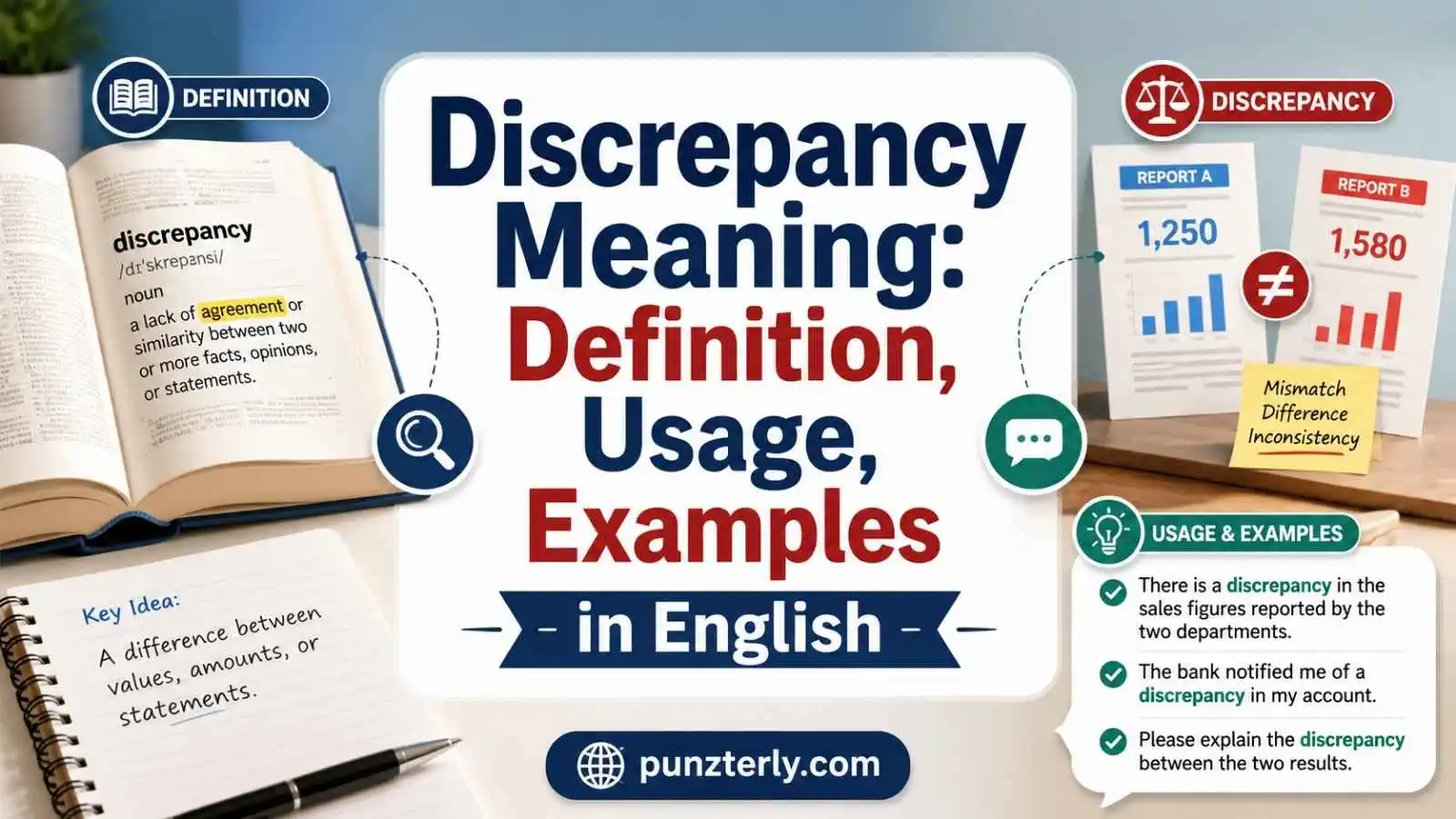
You may see discrepancy in school papers, bills, bank records, news stories, reports, or office emails. The word often appears when two facts, numbers, names, or stories do not match.
This matters because a discrepancy usually needs attention. It may point to a mistake, missing detail, or unclear information. In serious settings, it can affect money, grades, records, or trust.
This guide explains the word in plain English. You will learn its definition, pronunciation, part of speech, sentence patterns, examples, related words, and common mistakes. You will also see when to use it and when a simpler word may work better.
Quick Answer
Discrepancy meaning is simple: it means a difference between things that should match. It is often used for records, numbers, facts, statements, or results.
TL;DR
• Discrepancy means a mismatch.
• It is a noun.
• It sounds formal but common.
• Use it when things should match.
• The plural is discrepancies.
• It is not slang.
What Discrepancy Means in Plain English
A discrepancy is a difference that feels wrong or unexpected. It happens when two things should agree, but they do not.
Think of a receipt that says $45. Your bank app shows $54. That mismatch is a discrepancy.
The word often carries a serious tone. It does not always mean someone lied. It means something needs to be checked.
Pronunciation, Part of Speech, and Forms
The simple pronunciation is dis-KREP-un-see. The stress is on KREP.
Discrepancy is a noun. You can use it as countable or uncountable.
• Singular: discrepancy
• Plural: discrepancies
• Countable: We found three discrepancies.
• Uncountable: There was some discrepancy in the data.
Do not use it as a verb. Say “find a discrepancy,” not “discrepancy the report.”
How to Use Discrepancy Correctly
The most common pattern is discrepancy between. Use it when you compare two things.
Example: There is a discrepancy between the invoice and the receipt.
Another common pattern is discrepancy in. Use it when the mismatch appears inside a record, report, or set.
Example: The manager noticed a discrepancy in the sales report.
Common verbs include:
• find a discrepancy
• notice a discrepancy
• explain a discrepancy
• correct a discrepancy
• resolve a discrepancy
Common Contexts Where You See Discrepancy
You will often see this word in serious or careful writing. It fits best when accuracy matters.
Common contexts include:
• bills and receipts
• bank records
• school records
• medical forms
• reports and surveys
• company records
• witness statements
• research results
A small mismatch can still be a discrepancy. The key idea is that the items were expected to match.
Discrepancy Examples in Sentences
Here are clear examples you can copy or adapt.
• The bill showed a discrepancy in the final amount.
• There was a discrepancy between her story and the report.
• The teacher found a discrepancy in the attendance record.
• We need to explain the discrepancy before Friday.
• The two apps showed a small discrepancy in mileage.
• A payroll discrepancy delayed the employee’s check.
• The audit found several discrepancies in the records.
• Please contact us if you notice any discrepancy.
The word works well in formal emails. In casual speech, “mismatch” or “difference” may sound more natural.
Discrepancy vs Difference, Disparity, and Error
These words are related, but they are not always the same. Use discrepancy when two things should match.
| Context | Best Choice | Why |
| Two records do not match | Discrepancy | They should agree. |
| Two things are simply not the same | Difference | No problem is implied. |
| One group has much more than another | Disparity | It points to unequal levels. |
| Something is clearly wrong | Error | It names a mistake. |
Example: A price on a tag and a price at checkout may show a discrepancy. A red shirt and a blue shirt show a difference.
A pay gap between two groups may be called a disparity. A typed number with the wrong digit is an error.
Synonyms and Antonyms of Discrepancy
Good synonyms depend on the sentence. Some are close, but not perfect.
Close synonyms include:
• mismatch
• inconsistency
• difference
• variance
• disagreement
• conflict
• gap
Use mismatch for simple speech. Use inconsistency for facts or statements. Use variance for numbers or measured results.
Useful antonyms include:
• agreement
• consistency
• match
• similarity
• harmony
Not every antonym fits every sentence. For records, match or consistency usually works best.
Common Mistakes and Easy Fixes
One common mistake is using discrepancy for every difference. Not every difference is a problem.
Weak: There is a discrepancy between coffee and tea.
Better: There is a difference between coffee and tea.
Another mistake is using the wrong preposition.
Weak: A discrepancy of the two reports exists.
Better: A discrepancy between the two reports exists.
Also remember the plural form. Write discrepancies, not discrepancys.
FAQs About Discrepancy
What does discrepancy mean?
A discrepancy is a difference between things that should match. It often means a record, number, fact, or statement needs review.
What is an example of a discrepancy?
A receipt says $30, but your card charge says $35. That difference is a discrepancy because the amounts should match.
Is discrepancy a formal word?
Yes, it sounds formal. It is common in reports, emails, records, school work, and business writing.
Is discrepancy slang?
No, discrepancy is not slang. It is standard English and works best in careful writing.
How do you pronounce discrepancy?
Pronounce it dis-KREP-un-see. The strongest beat is on the second part, KREP.
Is discrepancy a noun?
Yes, discrepancy is a noun. The plural form is discrepancies.
What is the difference between discrepancy and disparity?
A discrepancy is a mismatch between things that should agree. A disparity is often a large or important difference between levels, amounts, or groups.
Mini Quiz
Choose the best answer.
- A discrepancy is usually:
A) a perfect match
B) a mismatch
C) a greeting - Which sentence is correct?
A) There is a discrepancy between the two reports.
B) There is a discrepancy at the two reports. - What is the plural of discrepancy?
A) discrepancys
B) discrepancies
C) discrepancyes - Which word is closest in meaning?
A) inconsistency
B) celebration
C) permission
Answer key: 1-B, 2-A, 3-B, 4-A.
Conclusion
Discrepancy meaning is about a mismatch between things that should match. The word is useful when accuracy matters.
Use it for records, numbers, facts, reports, and statements. For simple everyday differences, use “difference” or “mismatch” instead.
