
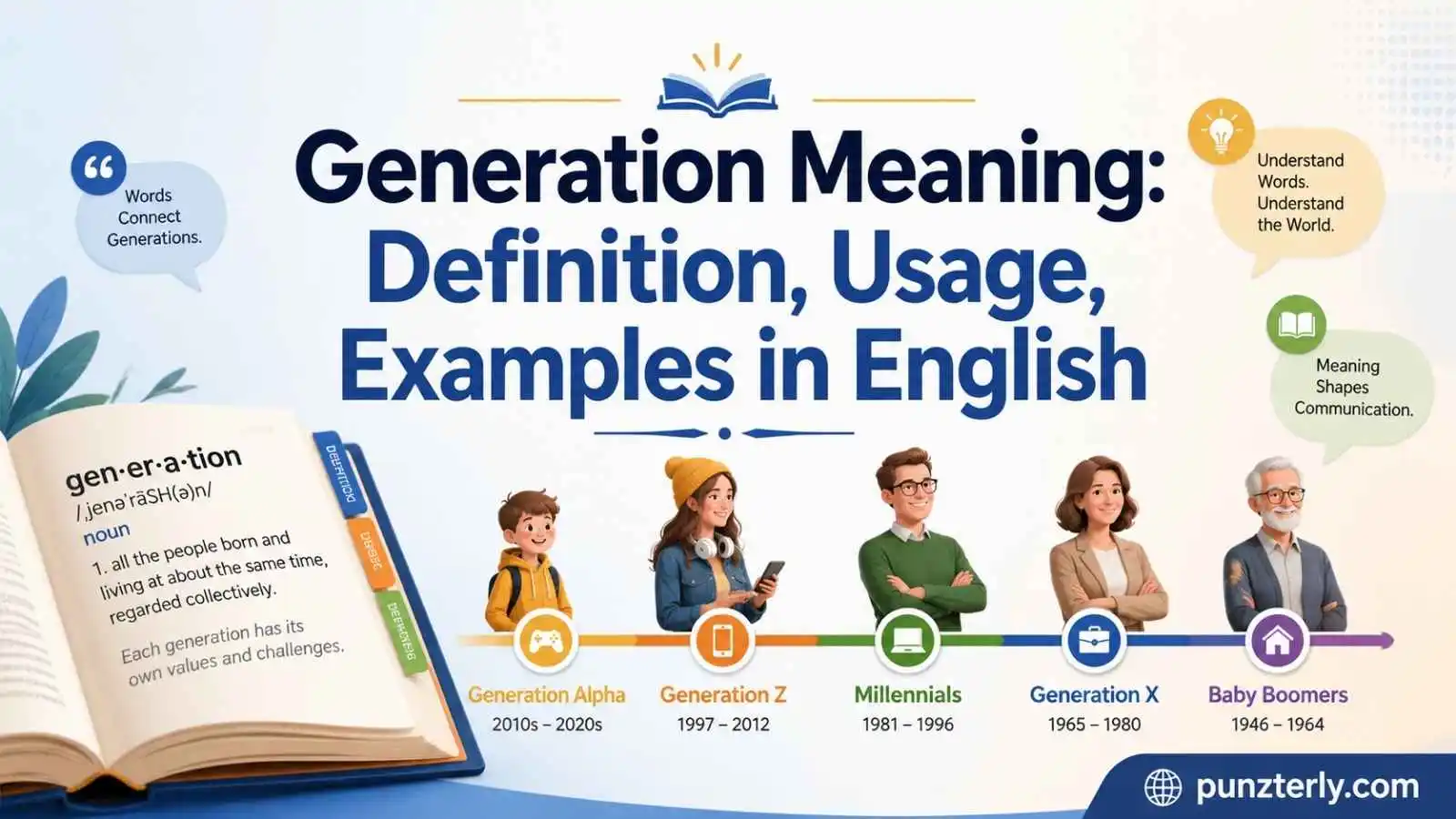
You may see the word “generation” in school, family stories, news, and product names. People use it when they talk about parents, children, age groups, and newer versions of things.
The word matters because its meaning changes with context. In one sentence, it may mean people born around the same time. In another sentence, it may mean one level in a family. It can also mean the production of power, heat, ideas, or products.
This guide explains the word in plain English. You will learn its main definitions, pronunciation, part of speech, common uses, examples, and mistakes to avoid. You will also see when the word does not mean slang.
Quick Answer
The generation meaning is a group, stage, or act connected by time, family, or production. It is most often a noun.
A generation can mean people born around the same time, one family level, a product stage, or the act of producing something.
TL;DR
• “Generation” is usually a noun.
• It often means an age group.
• It can mean one family level.
• It can mean a product stage.
• It can mean production or creation.
• It is not usually slang.
What Generation Means in Plain English
A generation is a group connected by time or order. Most often, it means people born and living around the same period.
In a family, it means one level in the family line. Your grandparents are one generation. Your parents are another generation. You and your siblings are another.
It can also mean a stage in development. A “new generation of phones” means a newer version or type.
Main Definitions of Generation
“Generation” has several common meanings. The right meaning depends on the sentence.
• People of similar age: “Her generation grew up with smartphones.”
• A family level: “Three generations came to the reunion.”
• A time span: “A lot can change in one generation.”
• A product stage: “This is the next generation of laptops.”
• Production: “The plant handles electricity generation.”
The word can sound simple, but context matters. Do not use one meaning for every sentence.
| Context | Best Choice | Why |
| People born around one time | generation | It points to a shared age group. |
| Family levels | generation | It shows parent-child order. |
| Product versions | generation | It shows a newer stage. |
| Making power or heat | generation | It means production. |
Pronunciation and Part of Speech
“Generation” is pronounced jen-uh-RAY-shun. The strong sound is on RAY.
It is mainly a noun. You can count it, so you can say “one generation” or “many generations.”
It can also help modify another noun in compounds. In “first-generation student,” the full phrase describes the student.
Examples:
• “The younger generation uses different apps.”
• “My family has lived here for four generations.”
• “She is a first-generation college student.”
How to Use Generation in Sentences
Use “generation” when you mean a shared time, a family level, or a stage. The phrase around it usually tells the reader which meaning you want.
Common phrases include:
• current generation
• younger generation
• older generation
• future generations
• next generation
• first-generation
• second-generation
• power generation
Examples:
• “The current generation faces new job challenges.”
• “This recipe has passed through generations.”
• “The next generation of cars may be quieter.”
• “Wind farms support power generation.”
Common Contexts for Generation
The word appears in many everyday places. You may see it in family records, school essays, news stories, ads, and science lessons.
In family talk, it shows relationships over time. In society, it groups people by age and shared experiences. In products, it shows a newer version.
In technical writing, it can mean production. For example, “heat generation” means heat being produced.
Generation in Family, Society, and Products
Family use is the easiest to picture. Grandparents, parents, and children are three generations.
Society use is broader. People may say “Generation Z,” “Baby Boomers,” or “the younger generation.” These labels can be useful, but they can also be too broad.
Product use is also common. A company may call a device “next generation.” This means it is newer than an earlier model.
Be careful with labels. Not everyone in one generation thinks or acts the same way.
Synonyms, Antonyms, and Related Terms
“Generation” does not have one perfect synonym. The best choice depends on the meaning.
Close synonyms include:
• age group — good for people of similar age
• cohort — more formal, often used in research
• lineage — useful for family descent
• stage — useful for product development
• production — useful for power or heat
There is no single exact antonym for “generation.” In some contexts, “individual” contrasts with a group. For production, “destruction” may contrast with creation.
Related words include “generate,” “generational,” and “generation gap.” “Generate” means to produce or create something.
Common Mistakes with Generation
One common mistake is using “generation” when you only mean age. A generation is not just one person’s age. It usually points to a group or family level.
Incorrect: “My generation is 24 years old.”
Correct: “I am 24 years old.”
Correct: “My generation grew up with streaming.”
Another mistake is treating labels as exact facts. People use names like “Millennial” or “Gen Z,” but birth-year ranges can vary by source.
A third mistake is forcing slang meaning. “Generation” is not usually slang. It is a normal English word used in many settings.
Mini Quiz
Choose the best answer.
- What part of speech is “generation” most often?
• A. Verb
• B. Noun
• C. Adverb - Which sentence uses “generation” for family?
• A. “Three generations attended dinner.”
• B. “The fan supports heat generation.”
• C. “This is a new generation of tablets.” - What does “next generation” usually mean?
• A. Older people
• B. A newer stage or version
• C. A family dinner - Is “generation” usually slang?
• A. Yes
• B. No
• C. Only in math
Answer key: 1-B, 2-A, 3-B, 4-B.
FAQs
What does generation mean?
“Generation” means a group or stage connected by time, family, or production. It often means people born around the same time.
It can also mean one family level. In another context, it can mean a newer product stage.
What is the simple meaning of generation?
The simple meaning is “a group connected by the same time or stage.” For people, it means an age group.
For family, it means one level, such as parents or children. For products, it means a version or stage.
How many years is a generation?
A generation is often described as about 20 to 30 years. This is only a general idea.
In family history, the length can change. People have children at different ages.
What does generation mean in family?
In family use, a generation is one level in the family line. Grandparents, parents, and children are separate generations.
Example: “Four generations live in the same town.” This means four family levels are alive.
What does generation mean in technology?
In product talk, “generation” means a stage or version. A new generation of phones means a newer group of phones.
It usually suggests change or improvement. Still, the exact change depends on the product.
Is generation a noun?
Yes, “generation” is mainly a noun. You can say “a generation” or “many generations.”
It also appears in compound phrases. Examples include “first-generation student” and “next-generation design.”
Is generation slang?
No, “generation” is not usually slang. It is a standard English word.
People may use it in slang-related topics, such as “Gen Z slang.” In that phrase, the slang belongs to the group, not the word “generation.”
Conclusion
The generation meaning depends on context, but the core idea is connection through time, family, stage, or production.
Use it for age groups, family levels, product versions, and production. Read the words around it to choose the right meaning.
