
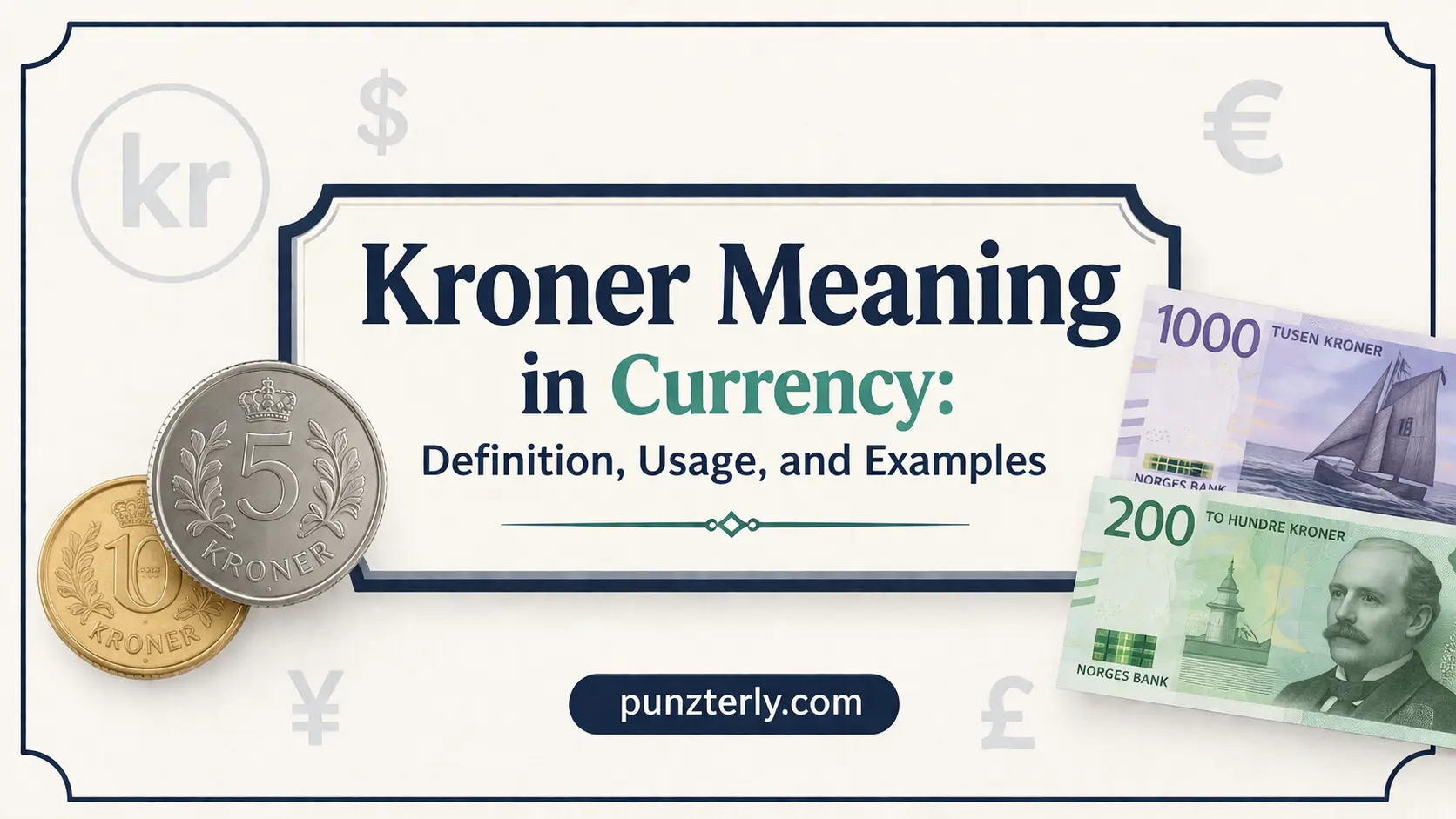
You may see kroner on travel sites, exchange-rate pages, bank apps, or news stories about Nordic countries. It often appears when someone talks about prices in Denmark or Norway, such as “50 kroner” or “200 kroner.”
The term matters because it is easy to confuse with krone, krona, and other similar currency names. Many learners also wonder if kroner is a real currency name, a plural word, or a broad label for several northern European currencies.
This guide explains the plain meaning of kroner, how to say it, when to use it, and when a more exact word is better. You will also see simple examples, common mistakes, and a short quiz to help you remember it.
Quick Answer
Kroner meaning currency usually refers to more than one krone, especially in Denmark and Norway.
In simple terms, kroner is the plural form of krone, a unit of money whose name means “crown.”
TL;DR
• Kroner is usually a plural noun.
• One krone, two kroner is the basic pattern.
• It is most exact for Denmark and Norway.
• Sweden usually uses krona/kronor instead.
• It names money, not a slang expression.
• Use it mainly with prices and currency talk.
What “Kroner” Means in Plain English
At its simplest, kroner means multiple units of a currency called krone.
Think of it like this:
• one dollar, two dollars
• one krone, two kroner
The word is tied to money used in Nordic countries. Its older meaning connects to the idea of a crown, which is why you may also see English explanations call it a “crown” currency.
Is “Kroner” Singular or Plural?
Kroner is usually plural.
That means you use it when the amount is more than one:
• 1 krone
• 5 kroner
• 100 kroner
A common learner mistake is writing krones. That is not the usual standard form.
Correct:
• I paid 40 kroner for lunch.
Not correct:
• I paid 40 krones for lunch.
Which Countries Does It Apply To?
In the most exact sense, kroner fits Danish and Norwegian currency use.
You will commonly see:
• Danish krone → plural kroner
• Norwegian krone → plural kroner
Related forms appear in nearby countries:
• Sweden uses krona and the plural kronor
• Iceland uses króna and a different plural form in Icelandic, though English sources may simplify it
So, if you are writing carefully in English, kroner is best used for Denmark and Norway.
Kroner vs. Krone vs. Krona
This is the part many pages explain poorly.
| Term | Best meaning | Why |
| krone | singular money unit | Use for one unit in Denmark or Norway |
| kroner | plural of krone | Use for two or more units |
| krona | related currency name | Used for Sweden, and also for Iceland in English references |
Here is the easy pattern:
• krone = one
• kroner = more than one
• krona = a related word used for Sweden, not the same form as Danish/Norwegian krone
So this sentence is natural:
• The ticket costs 80 kroner in Norway.
But this one needs care:
• Sweden uses kronor, not kroner, in standard usage.
Pronunciation
In simple American-style spelling, krone is often said like KROH-nuh.
Because kroner is the plural form, many learners say it close to KROH-nur.
Do not worry too much about perfect local pronunciation in everyday English. The main goal is to keep the first part sounding like kroh.
A common confusion is saying it like crown-er. That is not the usual English dictionary style.
Part of Speech and Word Type
Kroner is a noun.
More specifically, it is a count noun plural because you can count the units:
• 10 kroner
• 250 kroner
It is not a verb, adjective, or adverb. In normal English use, it works as a money word inside price statements, financial news, and travel writing.
How to Use “Kroner” in a Sentence
You usually use kroner after a number.
Examples:
• The museum pass costs 120 kroner.
• We exchanged dollars for kroner at the airport.
• Hotel prices in Oslo can be several hundred kroner per night.
• She paid 75 kroner for coffee and a pastry.
You can also use it in general money talk:
• The app shows prices in kroner.
• Their budget was listed in Danish kroner.
A helpful pattern is:
• number + kroner
• amount in + kroner
When to Be Exact and When Broad Use Is Fine
Sometimes people use kroner loosely to talk about Nordic “crown” currencies as a group. In casual speech, many readers will understand that.
Still, exact wording is better when the country matters.
Use kroner when:
• you mean Danish or Norwegian money
• you are giving a price in Denmark or Norway
• you are explaining the plural of krone
Be more exact when:
• you are writing about Sweden
• you are describing Iceland’s currency form
• you are making a chart, lesson, or formal guide
Small comparison
| Context | Best Choice | Why |
| Price in Copenhagen | kroner | Danish plural form |
| Price in Oslo | kroner | Norwegian plural form |
| Price in Stockholm | kronor | Swedish standard form |
| General Nordic travel talk | kroner or local term | Broad use may be understood, but local term is clearer |
Related Terms, Synonyms, and Antonyms
There is no perfect everyday synonym for kroner because it is a specific currency name.
Close or helpful related terms include:
• krone — singular form
• krona — related currency name
• crown currency — broad English explanation
• Danish krone — exact national form
• Norwegian krone — exact national form
True antonyms do not really apply here. A currency name usually does not have a direct opposite.
Common Mistakes
1) Using krones
Wrong: 30 krones
Correct: 30 kroner
2) Using kroner for Sweden in careful writing
Less exact: 50 kroner in Sweden
Better: 50 kronor in Sweden
3) Thinking kroner is singular
Wrong: one kroner
Correct: one krone
4) Treating it like slang
Kroner is not internet slang here. It is a real money term.
5) Mixing up the symbol and the word
The written symbol may be kr, but the word in a sentence is still krone or kroner.
FAQ
What does kroner mean in currency?
It usually means more than one krone, a money unit used in Denmark and Norway. In plain English, it is the plural currency form.
Is kroner singular or plural?
It is usually plural. The singular form is krone.
What is the difference between krone and kroner?
Krone means one unit. Kroner means two or more units.
Is kroner used in Sweden?
In careful usage, Sweden uses krona for one and kronor for more than one. Some broad English pages blur the terms, but kronor is the better choice for Sweden.
What countries use kroner?
The clearest answer is Denmark and Norway. Related currency names are also used in Sweden and Iceland, but the forms are not exactly the same.
How do you pronounce krone?
A simple guide is KROH-nuh. In English, that is close enough for most learners.
What does the word originally mean?
It is linked to the idea of a crown. That is why these currencies are sometimes described as crown-based currency names.
Mini Quiz
1) Which sentence is correct?
A. one kroner
B. one krone
2) Which country most clearly fits kroner in careful English?
A. Norway
B. Sweden
3) Which is the correct plural?
A. krones
B. kroner
4) What kind of word is kroner?
A. noun
B. verb
5) Which sentence is better?
A. The meal cost 90 kroner in Oslo.
B. The meal cost 90 krone in Oslo.
Answer Key
- B
- A
- B
- A
- A
Conclusion
Kroner meaning currency is easiest to understand this way: it is the plural form of krone, especially for Denmark and Norway.
Once you know one krone and two kroner, the pattern becomes simple.
The next step is to watch how the word appears in real prices and travel examples.
