
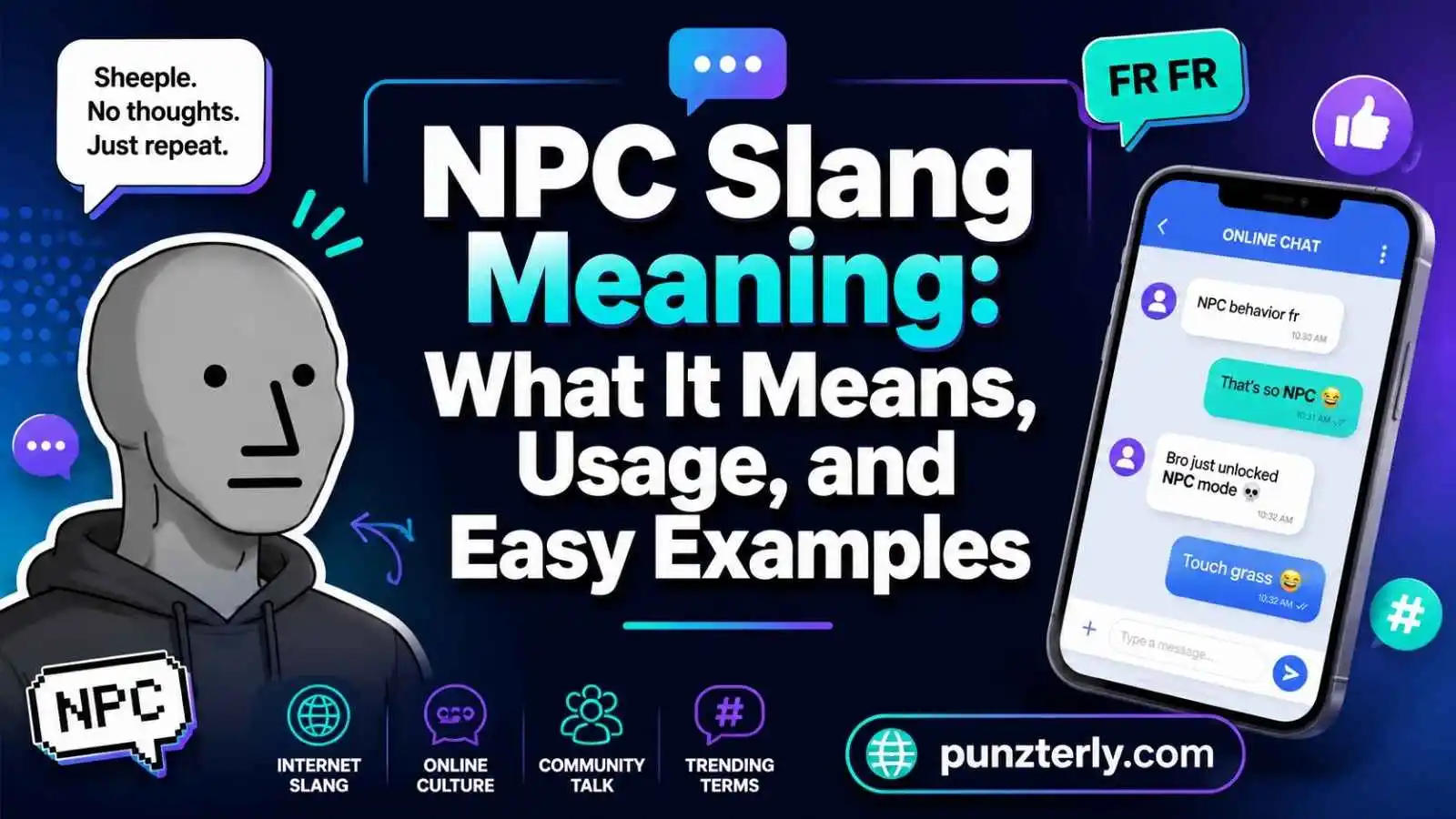
You may see “NPC” in texts, memes, TikTok comments, gaming chats, or online jokes. It is short, easy to type, and often used as a quick roast.
The word started in games, but it now has a slang meaning too. In slang, it often describes someone who seems scripted, dull, or too predictable.
That meaning can sound funny in a joke. It can also sound rude when aimed at a real person.
This guide explains what NPC means, how people use it, how to say it, and when to avoid it. You will also see examples, related terms, and a short quiz.
Quick Answer
The NPC slang meaning is a person who seems scripted, predictable, or like a background character. It comes from “non-player character” in games.
It is usually casual slang. It can be playful, but it can also be insulting.
TL;DR
• NPC means “non-player character.”
• In slang, it means scripted or predictable.
• It often describes boring repeated behavior.
• It can be a joke or an insult.
• Say it as “en-pee-see.”
• Use it carefully with real people.
What NPC Means in Plain English and Slang
In plain English, an NPC is a game character the player does not control. The character may sell items, give directions, or repeat the same line.
In slang, NPC means someone seems like that kind of character. The person may seem robotic, copied, or not very original.
It does not mean the person is truly less human. It is only a slang label. That is why tone matters so much.
Examples:
• “He says the same thing every morning. Total NPC energy.”
• “That answer sounded kind of NPC.”
• “Everyone wore the same outfit, and the joke was that we looked like NPCs.”
In these examples, NPC points to repeated behavior. It does not describe a real medical or mental state.
Part of Speech and Pronunciation
NPC is mainly a noun. You can say, “He is an NPC,” or “That character is an NPC.”
It can also work like an adjective in casual slang. People say “NPC behavior,” “NPC response,” or “NPC energy.”
Pronounce it by saying each letter:
• NPC = en-pee-see
Do not usually say it as one word. It is an acronym, so the letter-by-letter form is normal.
Where People Use NPC
People use NPC in gaming because it is a real game term. A player may talk to an NPC who gives a quest or sells items.
People also use it in online comments. In that setting, it often means someone seems boring, scripted, or trend-following.
Common places include:
• TikTok comments
• group chats
• gaming chats
• meme captions
• Discord conversations
• short posts on social media
On TikTok, NPC can also describe a livestream style. A creator may act like a game character and repeat lines when viewers send prompts.
That is different from calling someone an NPC. One is a performance style. The other is usually a roast.
How to Use NPC in a Sentence
Use NPC only in casual settings. It does not fit formal writing, school essays, work emails, or polite feedback.
Here are simple sentence patterns:
• “That was such an NPC response.”
• “He walked in, said one line, and left like an NPC.”
• “This store has the same music every day. NPC lobby vibes.”
• “I felt like an NPC standing in that long line.”
• “The joke was that we all looked like background characters.”
Notice that some examples are self-jokes. Those are safer than calling another person an NPC.
A common mistake is using NPC as a serious insult. A better choice is to explain the behavior.
Context table:
| Context | Best Choice | Why |
|---|---|---|
| Joking about yourself | “I felt like an NPC.” | Low risk and playful |
| Teasing a close friend | “That was NPC energy.” | Works only if they understand |
| Talking to a stranger | Avoid it | It may sound rude |
| Formal writing | Use “predictable” | Clear and respectful |
When Not to Use NPC
Avoid NPC when the person may feel mocked. It can sound like you are saying they cannot think for themselves.
Do not use it in serious conflict. It can make the other person feel dismissed instead of heard.
Avoid it in these cases:
• during arguments
• at work or school
• with strangers online
• when talking about beliefs
• when someone is already upset
A better choice is to name the behavior. Say “That reply felt repeated” instead of “You are an NPC.”
This keeps the meaning clear. It also sounds more mature.
Related Terms, Synonyms, and Antonyms
NPC has close related terms, but not perfect synonyms. Most choices depend on tone.
Close terms:
• scripted — sounds planned or repeated
• robotic — sounds stiff or automatic
• predictable — easy to guess
• background character — not central in a scene
• bot — very similar, but often means fake or automated
• basic — common or unoriginal, often rude
There is no exact antonym for NPC in slang. The closest phrase is “main character energy.”
That phrase means someone seems confident, present, or central. Still, it is not a perfect opposite.
Better opposites include:
• original
• independent
• expressive
• self-aware
• confident
Use these only when they match the sentence.
Origin and History of NPC
NPC comes from games. It means “non-player character” or “non-playable character.”
In games, an NPC is not controlled by the player. It may follow set actions, repeat lines, or help move the story along.
The slang meaning grew from that idea. Online users began applying it to real people who seemed scripted or unoriginal.
The full history is not perfectly simple. It passed through gaming culture, meme culture, and social media before becoming common slang.
The safest way to explain it is this: NPC began as a gaming term. Today, it also works as internet slang.
Common Mistakes
One mistake is thinking NPC always means a game character. In modern slang, it can also refer to a real person.
Another mistake is using it as a harmless word in every setting. It is not always harmless.
Common mistakes and fixes:
• Mistake: “NPC is always funny.”
Correction: It can offend someone.
• Mistake: “NPC means stupid.”
Correction: It means scripted, predictable, or unoriginal.
• Mistake: “NPC is formal English.”
Correction: It is casual slang.
• Mistake: “NPC only means TikTok streamer.”
Correction: That is one modern use, not the only use.
• Mistake: “Non-player and non-playable are totally different here.”
Correction: Both forms point to the same basic game idea.
Mini Quiz
- What does NPC stand for?
- Is NPC formal or casual?
- What does “NPC response” usually mean?
- Is “main character energy” an exact antonym?
- Which is safer: “You are an NPC” or “That reply felt repeated”?
Answer key:
- Non-player character or non-playable character.
- Casual.
- A scripted or predictable answer.
- No, but it is related.
- “That reply felt repeated.”
FAQs
What does NPC mean in slang?
NPC means someone seems scripted, predictable, or unoriginal. It compares a real person to a background game character.
It is casual internet slang. It can be funny or rude, depending on tone.
What does NPC stand for?
NPC stands for “non-player character.” Some people also say “non-playable character.”
Both forms refer to a game character controlled by the game, not the player.
What does it mean when someone calls you an NPC?
It usually means they think you seem boring, scripted, or too predictable. It may also mean they think you follow trends without thinking.
That can feel insulting. The meaning depends on the relationship and context.
Is NPC an insult?
Yes, it can be an insult. It is often used to mock someone’s behavior or opinions.
It can also be playful between close friends. Still, it is safer to use it carefully.
What does NPC mean on TikTok?
On TikTok, NPC can mean a person who seems robotic or scripted. It can also refer to creators who act like game characters on livestreams.
Those creators may repeat phrases and reactions for entertainment. That use is performance-based.
What does NPC mean in text?
In text, NPC usually means someone gave a flat or predictable response. It may also describe someone acting like a background character.
Example: “He just said ‘okay’ again. NPC reply.”
What is the opposite of NPC?
There is no perfect opposite. People often use “main character energy” as a related contrast.
That phrase means someone seems confident, expressive, or central. It is slang too.
Conclusion
NPC slang meaning is simple once you know the game origin. It describes someone who seems scripted, predictable, or like a background character.
Use it for casual jokes, not serious labels. When in doubt, describe the behavior instead.
