
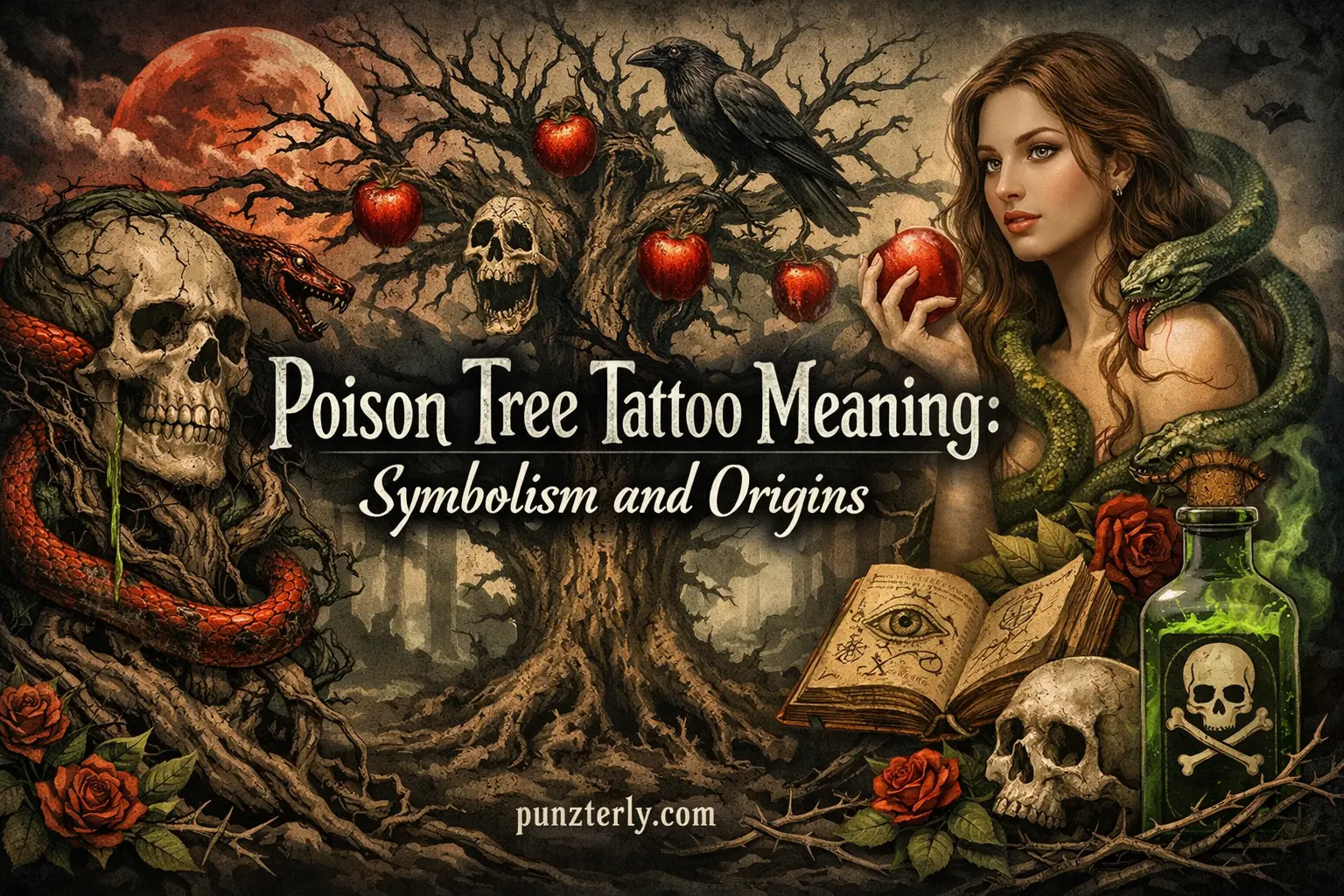
A poison tree tattoo usually symbolizes hidden anger, resentment, emotional pain, betrayal, or bitterness that grows when it is not faced openly. The meaning is most strongly connected to William Blake’s poem “A Poison Tree,” where unspoken wrath becomes a dangerous tree with poisoned fruit.
That makes this tattoo different from a normal tree tattoo. A regular tree often represents life, family, strength, growth, or spiritual connection. A poison tree represents growth in a darker direction. It shows what can happen when pain is buried, anger is fed, and resentment takes root.
For some people, the tattoo is a warning. For others, it marks survival after betrayal, a toxic relationship, or a painful chapter. It can also represent healing, self-awareness, and the choice to stop letting bitterness grow.
Quick Answer: What Does A Poison Tree Tattoo Mean?
A poison tree tattoo means that a harmful emotion has grown over time. Most often, that emotion is hidden anger, resentment, bitterness, or emotional pain.
The simplest meaning is:
A poison tree tattoo represents anger that was buried instead of expressed.
Common meanings include:
- Hidden anger
- Suppressed emotions
- Resentment
- Betrayal
- Revenge and consequences
- Toxic relationships
- Emotional pain
- Self-awareness
- Healing after bitterness
- A warning not to let anger take root
The symbol is dark, but it is not always negative. Many people use it as a reminder to speak honestly, release resentment, and choose healing before pain becomes destructive.
Meaning At A Glance
| Symbol | Common Meaning |
|---|---|
| Poison Tree | Hidden anger, resentment, emotional danger |
| Roots | Old wounds, buried pain, unresolved conflict |
| Trunk | Strength of the emotion over time |
| Branches | How anger spreads into thoughts and relationships |
| Apple Or Fruit | Consequence, temptation, revenge, danger |
| Thorns | Boundaries, defense, bitterness, protection |
| Flowers | Healing, recovery, transformation |
| Snake | Betrayal, temptation, deception |
| Dead Branches | Loss, emotional burnout, grief |
| Split Tree | Choice between bitterness and healing |
The William Blake Origin Of The Poison Tree Tattoo
The strongest source behind the poison tree tattoo meaning is William Blake’s poem “A Poison Tree.” Blake’s poem was published in 1794 in Songs of Experience. The poem contrasts two kinds of anger: anger that is spoken and anger that is hidden.
When the speaker tells a friend about his anger, the anger ends. When he hides anger from an enemy, the anger grows. Blake turns that hidden wrath into a tree, and the tree produces bright, dangerous fruit.
That image is the heart of the tattoo’s symbolism.
The tree is not just a plant. It is a metaphor for anger that has been watered, fed, and allowed to grow in secret. The poisoned fruit represents the result of that emotional growth: revenge, harm, consequence, or moral corruption.
This is why a poison tree tattoo often feels literary, psychological, and personal. It is not only about darkness. It is about what hidden emotion can become.
The Core Symbolism Of A Poison Tree Tattoo
Hidden Anger
The most direct meaning is hidden anger. The tattoo can represent anger that was never spoken, resolved, or released.
This meaning fits someone who wants the tattoo to say:
“I know what silence can do.”
It can also be a reminder that pretending not to be angry is not the same as healing.
Resentment And Bitterness
A poison tree can symbolize resentment that has grown slowly. This may come from betrayal, heartbreak, family conflict, rejection, or a long period of being unheard.
The tree image works because resentment often grows beneath the surface before it becomes visible. Like roots underground, it spreads quietly.
Betrayal And Broken Trust
A poison tree tattoo can also represent betrayal. The fruit may look beautiful, but it is poisonous. That makes it a strong symbol for something or someone that seemed safe but caused harm.
This meaning works especially well with designs that include:
- A red apple
- A snake
- Thorns
- Dead branches
- Dark roots
- A cracked heart or broken fruit
Toxic Relationships
For some wearers, the poison tree represents a toxic relationship. The tree may symbolize what grew from manipulation, silence, jealousy, emotional control, or repeated hurt.
In this context, the tattoo can mean:
- “I survived something toxic.”
- “I learned what emotional poison looks like.”
- “I will not let another person’s bitterness become mine.”
- “I choose boundaries now.”
Revenge And Consequence
Because Blake’s poem has a dark ending, the poison tree can also point to revenge or the consequences of hatred.
That does not mean every poison tree tattoo celebrates revenge. Often, it means the opposite. It can be a warning against feeding anger until it becomes destructive.
Healing And Self-Awareness
A poison tree tattoo can also mean healing. The wearer may choose it after realizing how anger, grief, or bitterness affected them.
In this version, the tattoo is not saying, “I am poisoned.”
It is saying:
“I understand what hurt me, and I am not letting it control me anymore.”
Flowers, new leaves, sunlight, broken fruit, or birds flying away can make the healing meaning clearer.
Why The Tree Symbol Matters
Trees are usually positive symbols. They represent growth, roots, family, endurance, wisdom, and life. A poison tree changes that meaning by showing that not all growth is healthy.
A poison tree asks a harder question:
What are you growing inside yourself?
The roots can represent the origin of pain. The trunk can represent how strong the emotion became. The branches can show how it spread. The fruit can show the final consequence.
That layered meaning is why the design works so well as a tattoo. It can hold a whole emotional story in one image.
Poison Tree Tattoo Design Ideas And Meanings
Poison Tree With Apple
A poison tree with an apple is one of the clearest Blake-inspired designs. The apple represents the fruit of hidden anger.
It can mean:
- Temptation
- Revenge
- Consequence
- Danger hidden inside beauty
- A harmful result of resentment
- Something attractive but destructive
A black tree with one red apple is a strong design because the color contrast makes the meaning easy to read.
Poison Tree With Roots
Visible roots make the tattoo feel deeper and more personal. They suggest that the anger or pain did not appear suddenly. It came from somewhere.
This design can mean:
- Old wounds
- Family pain
- Childhood hurt
- Buried trauma
- Unresolved conflict
- The need to heal from the root
This is one of the best designs for someone who wants the tattoo to represent self-awareness or recovery.
Poison Tree With Thorns
Thorns add the meaning of protection. They can show that pain made the wearer defensive or cautious.
This design can mean:
- Boundaries
- Bitterness
- Self-protection
- Emotional armor
- Hurt that changed the wearer
A thorny poison tree can look darker, but it can also feel empowering when the meaning is about protection rather than revenge.
Poison Tree With Flowers
Flowers soften the tattoo. They show that beauty, healing, or growth can still exist around pain.
This design can mean:
- Recovery after bitterness
- Healing after betrayal
- Choosing peace
- Growth after a toxic chapter
- Transformation without denying the past
A poison tree with flowers is a strong option if the wearer wants the tattoo to feel reflective rather than purely dark.
Poison Tree With Snake
A snake adds meanings of temptation, secrecy, betrayal, and deception. Because trees, fruit, and snakes often appear together in moral and mythic imagery, this design can feel symbolic and dramatic.
It may represent:
- Manipulation
- Betrayal
- Dangerous desire
- Hidden truth
- A lesson learned the hard way
This design works best for someone comfortable with a darker visual style.
Dead Poison Tree
A dead poison tree can represent emotional exhaustion, grief, loss, or the end of a painful cycle.
It can mean:
- “That chapter is over.”
- “The anger burned out.”
- “I survived the damage.”
- “Nothing more will grow from that pain.”
This design often works well in blackwork, fine line, or gothic styles.
Split Healthy And Poisoned Tree
A split tree shows contrast. One side may be alive, flowering, or bright. The other side may be dark, dead, thorny, or poisoned.
This design can mean:
- Inner conflict
- Choice
- Healing versus bitterness
- Past versus future
- Shadow and self-awareness
- The decision not to keep feeding anger
This is one of the strongest designs for transformation.
Minimal Poison Tree
A minimal poison tree tattoo may use a small tree, simple roots, one apple, or a thin branch.
It can mean:
- Quiet strength
- Private pain
- A personal reminder
- Emotional control
- A subtle Blake reference
Minimal designs work well on the wrist, inner arm, ankle, collarbone, behind the ear, or nape of the neck.
Gothic Poison Tree
A gothic poison tree tattoo often includes black ink, dead branches, ravens, skulls, snakes, moons, heavy shading, or dark fruit.
It can mean:
- Hidden rage
- Shadow work
- Grief
- Revenge
- Mortality
- Toxic love
- Survival through darkness
This style is visually powerful, but it is also more likely to be read as dark or aggressive.
Best Tattoo Styles For A Poison Tree Design
| Style | Best For |
|---|---|
| Fine Line | Minimal, delicate, personal designs |
| Blackwork | Bold dark symbolism and strong contrast |
| Gothic | Dramatic themes of grief, shadow, and danger |
| Illustrative | Literary Blake-inspired scenes |
| Realism | Detailed trees, roots, apples, and texture |
| Neo-Traditional | Strong outlines, rich color, symbolic fruit |
| Abstract | Emotional intensity without literal imagery |
| Dotwork | Texture, roots, shadows, and spiritual tone |
| Watercolor | Healing, release, and emotional transition |
The best style depends on the meaning. A revenge-focused design may look better in blackwork or gothic style. A healing-focused design may work better with flowers, soft shading, or fine-line details.
Best Placements For A Poison Tree Tattoo
| Placement | Why It Works |
|---|---|
| Forearm | Visible reminder to speak honestly and avoid resentment |
| Wrist | Small personal symbol for emotional awareness |
| Upper Arm | Good space for roots, branches, fruit, or quotes |
| Chest | Emotional placement close to the heart |
| Ribcage | Private, intense, and good for literary quotes |
| Back | Best for large tree designs with full detail |
| Spine | Strong symbol of transformation and inner growth |
| Thigh | Enough room for roots, flowers, and shading |
| Shoulder Blade | Personal but easy to cover |
| Hand | Bold and highly visible |
| Neck Or Nape | Vulnerable, symbolic, and intimate |
Large poison tree tattoos usually work best on the back, thigh, chest, or upper arm because the artist has more room for branches, roots, and fruit. Small designs should stay simple so they do not blur over time.
Poison Tree Tattoo Color Meanings
| Color | Meaning |
|---|---|
| Black | Grief, secrecy, shadow, seriousness |
| Red | Anger, danger, blood, passion, warning |
| Green | Poison, jealousy, growth, nature |
| Gray | Sadness, memory, emotional heaviness |
| Purple | Mystery, inner conflict, spiritual depth |
| White | Release, clarity, healing |
| Gold | Tempting beauty, false brightness |
| Blue | Sadness, calm, emotional distance |
| Brown | Roots, memory, the past |
A black tree with red fruit is one of the clearest poison tree designs. Black shows the darkness of hidden emotion, while red highlights danger, anger, and consequence.
Poison Tree Tattoo Quotes
Short quotes work best because long tattoo text can blur or become hard to read over time.
Strong quote ideas include:
- “My wrath did grow.”
- “Let no poison take root.”
- “Do not water resentment.”
- “What is hidden still grows.”
- “Speak before it grows.”
- “Buried anger bears bitter fruit.”
- “No more poison.”
- “From roots to ruin.”
- “I choose release.”
- “Healing begins at the root.”
- “The fruit remembers the root.”
The most literary option is “My wrath did grow” because it directly echoes Blake’s poem while staying short enough for a tattoo.
Poison Tree Tattoo Vs. Similar Symbols
| Tattoo Symbol | Main Meaning | Difference |
|---|---|---|
| Poison Tree | Hidden anger, resentment, consequence | Literary and emotional |
| Tree Of Life | Growth, family, connection, spirituality | More positive and universal |
| Dead Tree | Grief, loss, emptiness, survival | Less focused on anger |
| Poison Apple | Temptation, danger, beauty hiding harm | Focuses on the result, not the growth |
| Forbidden Fruit | Desire, sin, temptation, moral risk | More biblical or mythic |
| Thorn Tree | Pain, boundaries, endurance | Less tied to Blake |
| Burning Tree | Destruction, purification, rebirth | More active and intense |
| Willow Tree | Grief, memory, softness, mourning | Gentler emotional tone |
| Oak Tree | Strength, wisdom, endurance | Stable and heroic |
A poison tree tattoo is the strongest choice when the main idea is anger or pain that grew because it was hidden.
Is A Poison Tree Tattoo Negative?
A poison tree tattoo is dark, but it is not always negative.
The original image is about hidden anger and destructive consequences. That gives the tattoo emotional weight. But many wearers choose it as a warning, not a celebration of bitterness.
It can mean:
- “I survived betrayal.”
- “I know what resentment can do.”
- “I will not feed anger anymore.”
- “I choose honesty over silence.”
- “I turned pain into self-awareness.”
- “I am healing from something toxic.”
The meaning depends on the design and the person wearing it.
Is A Poison Tree Tattoo Evil?
No, a poison tree tattoo is not automatically evil. It may look dark, but its meaning is usually symbolic.
It can represent the danger of hidden anger, the consequences of resentment, or the need to heal from emotional poison. Some designs may look more sinister if they include skulls, snakes, blood, or dead branches, but that does not make the tattoo evil.
The better interpretation is this:
A poison tree tattoo shows the danger of letting pain grow unchecked.
Spiritual Meaning Of A Poison Tree Tattoo
Spiritually, a poison tree tattoo may represent the shadow side of the self. It can symbolize emotions that people often hide, such as anger, jealousy, grief, resentment, or revenge.
In this meaning, the tattoo is about facing what is hidden.
It may represent:
- Shadow work
- Emotional purification
- Karmic consequence
- Moral choice
- Temptation
- Release of bitterness
- Transformation through self-knowledge
A spiritual poison tree tattoo does not have to mean darkness wins. It can mean the wearer has chosen to face darkness honestly.
Psychological Meaning Of A Poison Tree Tattoo
Psychologically, the poison tree tattoo represents suppressed emotion. It shows what can happen when anger or pain is pushed down instead of processed.
It may symbolize:
- Repressed anger
- Unresolved conflict
- Emotional avoidance
- Resentment loops
- Toxic coping patterns
- Delayed grief
- Fear of confrontation
- Self-protection after betrayal
For some people, the tattoo becomes a reminder to communicate, set boundaries, and deal with pain before it turns into bitterness.
Biblical And Moral Interpretations
A poison tree tattoo is not originally a biblical symbol. Its strongest source is William Blake’s poem. However, some people connect the image to biblical or moral themes because of the tree, fruit, temptation, and consequence imagery.
A biblical-style interpretation may connect the tattoo with:
- The danger of bitterness
- Temptation
- Moral consequence
- The fruit of hidden sin
- Anger that damages the heart
- The need for forgiveness or release
This interpretation is personal. The tattoo does not have one fixed religious meaning.
Poison Tree Tattoo Meaning For Men And Women
The meaning does not change by gender. A poison tree tattoo can represent hidden anger, betrayal, emotional survival, healing, or self-awareness for anyone.
Some men may connect the tattoo with emotional silence, pressure to suppress feelings, or learning that strength includes honesty.
Some women may connect it with reclaiming anger, surviving betrayal, or turning pain into boundaries and self-respect.
But the better way to think about it is not “male meaning” or “female meaning.” The stronger question is:
What part of the design tells your story?
How To Choose The Right Poison Tree Tattoo Design
Choose the design based on the message you want the tattoo to carry.
If you want the tattoo to mean hidden anger, choose dark roots, twisted branches, or a black tree.
If you want the Blake connection to be clear, add an apple, poisoned fruit, or a short quote.
If you want the tattoo to mean healing, add flowers, new leaves, light, birds, or broken fruit.
If you want it to represent betrayal, consider a snake, thorn branches, or a damaged apple.
If you want it to be private, choose a minimal design on the wrist, ribs, ankle, or inner arm.
If you want it to feel bold, choose the forearm, chest, back, hand, or thigh.
What To Tell Your Tattoo Artist
Before booking the tattoo, explain the meaning clearly. Do not only say “I want a poison tree.” Tell the artist what emotional direction matters most.
Useful things to say include:
- “I want it to represent hidden anger, not evil.”
- “I want the Blake poem connection to be clear.”
- “I want the design to feel healing, not revengeful.”
- “I want roots to show old pain.”
- “I want one apple to represent consequence.”
- “I want flowers to show recovery.”
- “I want it dark but still elegant.”
- “I want the quote readable years from now.”
This helps the artist design a tattoo that matches the story instead of just drawing a dark tree.
Size And Aging Tips
Poison tree tattoos often include thin branches, roots, fruit, leaves, and sometimes text. These details can blur if they are too small.
For a small tattoo, keep the design simple. A small tree, one apple, or a short branch works better than many tiny roots and leaves.
For a medium tattoo, the forearm, upper arm, calf, or shoulder gives enough space for roots and fruit.
For a large tattoo, the back, thigh, chest, or ribs can hold a full tree with branches, roots, quotes, flowers, and shading.
If you add text, use a short quote. Long lines from poetry may look good at first but can become hard to read as the tattoo ages.
Common Misreadings To Avoid
A poison tree tattoo can be misunderstood if the design is too vague or too aggressive.
People may think it means:
- Evil
- Revenge
- Violence
- Poison literally
- A random dead tree
- A toxic personality
- A horror tattoo with no deeper meaning
To avoid this, use design details that clarify your intention. Flowers, broken fruit, open branches, or a short quote can make the meaning more thoughtful. Skulls, blood, snakes, and heavy black shading will push the tattoo toward a darker interpretation.
Short Ways To Explain A Poison Tree Tattoo
If someone asks what the tattoo means, you can explain it simply:
- “It comes from William Blake’s poem about hidden anger.”
- “It reminds me not to let resentment grow.”
- “It represents pain I had to face.”
- “The tree shows what buried anger can become.”
- “The apple represents the consequence of silence.”
- “For me, it means healing after a toxic chapter.”
- “It is a warning not to water bitterness.”
Caption Ideas For A Poison Tree Tattoo
- Hidden anger grows roots.
- Let no poison take root.
- My wrath did grow.
- Buried pain bears bitter fruit.
- What is hidden still grows.
- Healing begins at the root.
- I stopped watering the anger.
- From poison to awareness.
- Not every tree grows from peace.
- Speak before it grows.
Who Should Get A Poison Tree Tattoo?
A poison tree tattoo may be right for someone who wants a design about:
- Hidden anger
- Resentment
- Betrayal
- Toxic relationships
- Emotional survival
- Shadow work
- Healing after pain
- Literary symbolism
- Self-awareness
- Boundaries
- Choosing peace over revenge
It is especially strong for someone who wants a tattoo with psychological or poetic meaning rather than a simple nature design.
Who Should Avoid A Poison Tree Tattoo?
This tattoo may not be the right choice if you want a purely positive tree symbol. It carries emotional weight and may be read as dark, intense, or painful.
You may prefer another symbol if you want meanings like:
- Family connection
- Peace
- Pure spiritual growth
- Nature beauty
- Rebirth without darkness
- Joy
- Protection without bitterness
In that case, a tree of life, olive branch, lotus, phoenix, oak tree, or willow tree may fit better.
FAQ
What does a poison tree tattoo mean?
A poison tree tattoo usually means hidden anger, resentment, emotional pain, or bitterness that grows when it is not expressed. It can also represent betrayal, toxic relationships, revenge, warning, healing, and self-awareness.
Is a poison tree tattoo based on William Blake?
Yes. The strongest meaning comes from William Blake’s poem “A Poison Tree,” where hidden wrath grows into a dangerous tree with poisoned fruit.
What does the apple mean in a poison tree tattoo?
The apple usually represents the result of hidden anger. It can symbolize temptation, revenge, danger, consequence, or harm disguised as beauty.
Does a poison tree tattoo mean revenge?
It can, but revenge is not the only meaning. More often, the tattoo represents the emotional path that can lead to revenge: hidden anger, secrecy, resentment, and unresolved pain.
Can a poison tree tattoo mean healing?
Yes. Many people use the poison tree as a healing symbol. In that context, it means the wearer has recognized their pain and chosen not to let resentment control them.
Is a poison tree tattoo negative?
It is dark, but not always negative. It can be a warning, a lesson, a literary symbol, or a sign of emotional growth after a painful experience.
Is a poison tree tattoo evil?
No. A poison tree tattoo is not automatically evil. It usually represents emotional danger, hidden anger, or the consequences of bitterness rather than evil itself.
What is the best placement for a poison tree tattoo?
The best placements are the forearm, upper arm, chest, back, ribs, thigh, wrist, and shoulder blade. Larger areas are better for detailed roots, branches, fruit, and quotes.
What color is best for a poison tree tattoo?
Black and red are the strongest colors. Black suggests secrecy, grief, and shadow, while red suggests anger, danger, passion, or warning.
Is a poison tree tattoo the same as a tree of life tattoo?
No. A tree of life tattoo usually means growth, family, connection, and spiritual life. A poison tree tattoo is darker and usually means hidden anger, resentment, or emotional harm.
What does a poison tree tattoo say about someone?
It may suggest that the wearer is reflective, emotionally aware, literary, or shaped by a painful experience they have learned from.
Can a poison tree tattoo be small?
Yes. A small poison tree tattoo can work well if the design is simple. A small tree, one apple, or minimal roots will age better than tiny detailed branches and text.
What is the simplest poison tree tattoo meaning?
The simplest meaning is: anger grows when it is hidden.
Final Thoughts
The poison tree tattoo meaning centers on hidden anger, resentment, betrayal, emotional pain, and the consequences of silence. Its strongest origin is William Blake’s poem “A Poison Tree,” where unspoken wrath grows into a dangerous tree with poisoned fruit.
But the tattoo does not have to be only dark. For many people, it is a symbol of healing, awareness, boundaries, and emotional honesty. It can show what pain became, what the wearer survived, and what they no longer want to feed.
A strong poison tree tattoo is not just a dark tree. It is a story about roots, growth, danger, consequence, and the choice to stop letting bitterness take over.
